
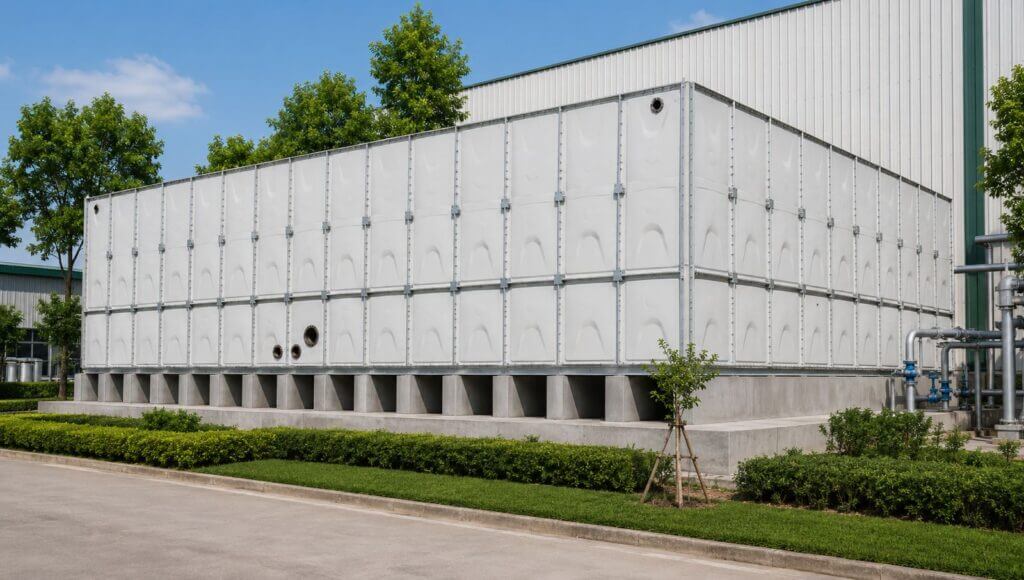
Almost every occupied building in the UAE depends on a rooftop water tank. It is the buffer between the municipal supply and the taps, and it is usually the last part of the plumbing anyone thinks about until something goes wrong. Yet a rooftop tank sits on a structure, holds several tonnes of water, feeds drinking water to residents and bakes in 50°C summer heat. Getting the design right matters. This guide covers how to specify rooftop water tanks for buildings in the UAE: which tank types suit a roof, how structural loading works, what the safety and hygiene requirements are, and how to size capacity properly.
Why Buildings in the UAE Rely on Rooftop Storage
Municipal water in the UAE is reliable, but it is not uninterrupted. Maintenance work, pressure drops and seasonal peaks all happen. Rooftop storage solves three problems at once:
- Continuity: the building keeps running through a supply interruption, typically for a full day or more.
- Pressure: a tank at height feeds the floors below by gravity, so upper floors get usable pressure without a pump running constantly.
- Peak demand: morning and evening demand in a residential tower far exceeds the incoming main. Storage absorbs the spike.
In most towers the rooftop tank works as part of a pair: an underground or ground-level tank receives the municipal supply, and a transfer pump lifts water to the roof. If you are planning the lower half of that system, our guide to underground water tanks in the UAE covers it in detail.
Which Tank Types Suit a Roof
Roof space is tight, access is usually through a staircase or a hatch, and the structure has a load limit. That rules out some options and favours others.
GRP Panel Tanks
Glass-reinforced plastic panel tanks are the most common choice for rooftop installations in the UAE, and for good reason. The panels are light, they arrive flat, and they can be carried up a stairwell and bolted together in place. A GRP tank also insulates far better than bare steel, which keeps stored water cooler. Read our complete guide to GRP panel water tanks for the full specification.
Sectional Steel Tanks
Zincalume or galvanised sectional steel tanks are stronger and better suited to large capacities and exposed positions. They are heavier per panel but still modular, so they can be assembled on a roof where a single moulded tank could never be lifted. For a side-by-side comparison of the materials, see steel vs GRP vs concrete water tanks.
Polyethylene Tanks
Moulded HDPE tanks are inexpensive and fine for a villa or a small compound where capacity is modest and the tank can be lifted into position whole. They do not scale: above roughly 5,000 litres you are better off with a panel tank, and a single large moulded tank is awkward to get onto a roof.
One thing all three share in the UAE: the tank must be opaque and properly covered. Sunlight through a translucent wall grows algae in days.
Structural Loading: The Number That Decides Everything
This is where rooftop projects go wrong. Water weighs one tonne per cubic metre. A 20,000-litre tank is 20 tonnes of water before you add the tank itself, and that load is not spread evenly — it concentrates on the base frame and the supports underneath.
Three points to settle before you order anything:
- Get the structural capacity confirmed in writing. A structural engineer should check the slab and the beams below it against the filled weight of the tank. For an existing building this means a survey, not an assumption.
- Spread the load. Panel tanks sit on a steel base frame or on plinths that transfer the load to beams and columns, not to the middle of a slab span. The support layout is part of the tank design, not an afterthought on site.
- Allow for the full tank. Size the structure for a completely full tank plus the weight of the tank, the frame and any insulation, with the appropriate safety factor. Never for the normal operating level.
If the roof cannot take the capacity you need, the usual answers are splitting into two smaller tanks positioned over structural supports, or moving the bulk of storage to ground level and keeping a smaller break tank on the roof.
Safety and Hygiene Requirements
A rooftop tank feeds drinking water, which puts it under health regulations as well as building ones. The essentials:
- Food-grade internal surfaces. Panels and liners in contact with potable water must be certified for drinking water contact.
- Sealed, lockable access. A hinged, lockable manhole cover keeps out dust, birds, insects and anyone who should not be in there.
- Screened vents and overflow. Every opening — vent, overflow, drain — needs an insect-proof screen. An unscreened overflow is the most common contamination route we see.
- Safe access for maintenance. A fixed ladder, a guarded walkway and fall protection where the tank is near a roof edge. Someone has to clean this tank twice a year.
- Air gap on the inlet. The fill pipe must discharge above the maximum water level so tank water can never be siphoned back into the supply.
- Separate fire storage. Fire-fighting water is normally kept in a dedicated tank. See fire water storage tanks in the UAE for the requirements.
Dealing With UAE Rooftop Heat
A dark tank on an unshaded roof in July will push stored water past 50°C. That is a scalding risk, it accelerates corrosion and liner ageing, and warm water encourages bacterial growth.
What actually works, in order of effectiveness:
- Insulate the tank. A properly insulated panel tank holds overnight temperature through the day. This is the single biggest improvement available.
- Shade it. A simple canopy over the tank removes the direct solar gain that does most of the damage.
- Insulate the pipework. Uninsulated exposed pipe on a hot roof undoes the work the tank insulation does.
- Keep water moving. A tank sized so far above demand that water sits for days will be hot and stale regardless of insulation.
Our guide to insulated water tanks and summer heat goes through the options and the temperature differences you can expect.
How to Size Rooftop Capacity
The common approach is to store one day of demand on the roof, with the larger reserve at ground level. For UAE residential buildings a reasonable planning figure is 150 to 250 litres per person per day, depending on the standard of the building and whether there is landscaping or a pool on the same supply.
A worked example for a small residential building:
- 24 apartments, average 3 occupants = 72 people
- 72 × 200 litres = 14,400 litres per day
- Round up for common areas and a margin: a 15,000 to 18,000-litre rooftop tank
Commercial buildings work differently — demand follows occupancy hours rather than people living there, and a building with a restaurant, a laundry or cooling make-up water needs a specific calculation rather than a per-head figure. Our water tank size calculator guide works through several building types with the arithmetic shown.
Two practical cautions. Do not oversize dramatically: a tank that turns over slowly gives you warm, stale water. And check the sized tank against the structural limit from the section above before you commit — the load, not the demand, often sets the final capacity.
Installation on an Occupied Building
Most rooftop work in the UAE happens on buildings that are already occupied, which changes the job considerably.
- Access route first. Measure the stairwell, the hatch and any turns before ordering. Panel sizes can usually be chosen to fit the route.
- Plan the shutdown. Replacing a live tank means the building loses water. Residents need notice, and a temporary supply or a staged changeover may be necessary.
- Base ready before delivery. The steel frame or plinths, levelled and checked, must be complete before panels arrive.
- Test, then disinfect. Fill and leak-test, then clean and disinfect before the tank is connected to the drinking water system.
Our water tank installation process guide sets out the full sequence from site survey to commissioning.
Keeping a Rooftop Tank Serviceable
Rooftop tanks are neglected because they are out of sight. A short routine prevents nearly every failure we are called out to:
- Clean and disinfect twice a year, and keep the records. See our tank cleaning and disinfection guide.
- Inspect the cover, vent screens and overflow screens quarterly.
- Check bolts, seals and panel joints annually for weeping or corrosion.
- Test the level control and float valve annually — a stuck float overflows a roof for days before anyone notices.
- Look underneath. Damp patches on the slab under a tank are the early warning of a leak.
If your existing tank is showing its age, the signs worth acting on are covered in our article on water tank replacement in the UAE.
Working With a Local Manufacturer
Al Karwan Solution FZC manufactures sectional steel and GRP panel water tanks in Sharjah and installs them across the UAE. Because the panels are made here rather than imported, dimensions can be adjusted to suit a roof and an access route, lead times are short, and support after installation is local.
For a rooftop project we normally need: the roof dimensions and available area, the structural capacity confirmed by your engineer, the access route, the required capacity or the occupancy to size from, and the water type. With that we can confirm a configuration and a price. See our services or browse completed projects.
Frequently Asked Questions
How long does a rooftop water tank last in the UAE?
A well-specified GRP or Zincalume sectional tank that is cleaned twice a year and kept shaded or insulated will typically give 15 to 25 years of service. Untreated steel in full sun with no maintenance can deteriorate in under ten. The variables that matter most are the coating or panel material, whether the tank is shaded, and whether it is actually cleaned.
Do I need structural approval for a rooftop water tank?
Yes. The filled weight of the tank has to be checked against the roof structure by a qualified structural engineer, and for most buildings the installation needs approval from the relevant municipality or authority. For an existing building this means a structural survey before the tank is specified, not after.
Can one rooftop tank supply both drinking water and fire-fighting water?
In most cases fire water is kept in a separate dedicated tank. Some designs combine the two with a protected fire reserve that cannot be drawn down by normal use, but this has to be approved by your consultant and the relevant authority before it is built.
What is the maximum size of rooftop tank you can install?
The structure sets the limit, not the tank. Our sectional tanks are available from 5,000 litres upward, and on a roof the practical ceiling is whatever the slab and beams will carry with the required safety factor. Where the required capacity exceeds the structural limit, we usually split it across two tanks over structural supports or move the bulk of storage to ground level.