
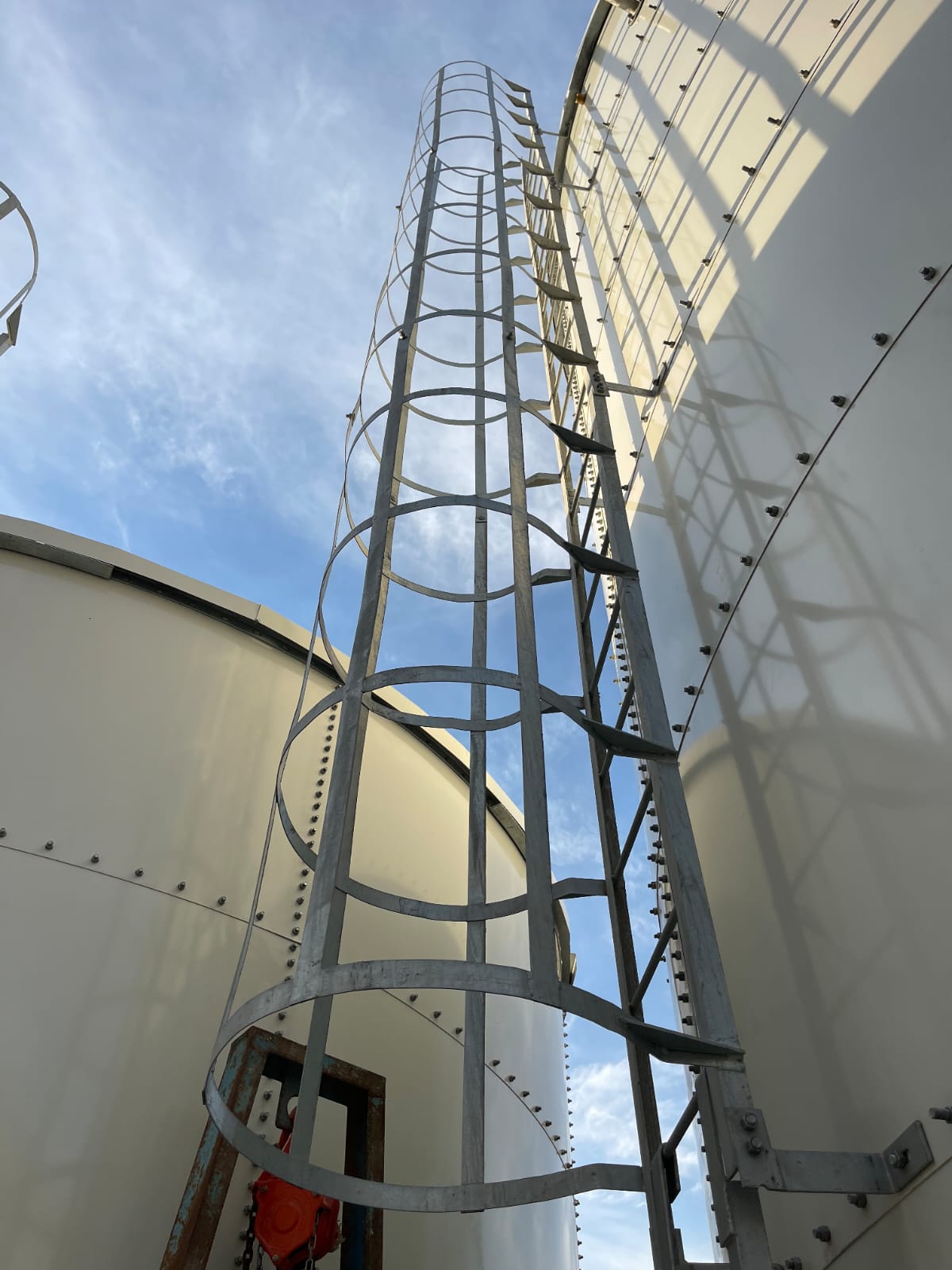
Water tanks fail slowly. A little corrosion, a damp patch on the slab, residents mentioning the water tastes odd — and then one morning a panel joint lets go and a building has no water. Most of the emergency replacements we are called out to in the UAE had been signalling for a year or more. This guide sets out seven signs that a water tank needs replacing rather than patching, how to judge repair against replacement, what a replacement actually involves on an occupied building, and how to plan it before it becomes an emergency.
1. Visible Rust, Pitting or Scale on the Panels
Surface staining on the outside of a steel tank is cosmetic. What matters is what is happening inside, and where.
Act on it when you see: rust that has pitted into the panel rather than sitting on it, corrosion concentrated around bolt holes and panel joints, flaking or blistering of the internal coating, or rust-coloured water at the taps when the tank is drawn down. Corrosion at joints is the serious case — that is where the structural load and the seal both are.
In UAE conditions, bare galvanised steel in full sun deteriorates considerably faster than Zincalume or a properly lined tank. If the tank is more than ten years old, unlined and unshaded, pitting at the joints usually means the tank is at the end of its service life rather than in need of a repair. Our comparison of GI vs Zincalume coatings explains why the material choice makes such a difference.
2. Leaks, Weeping Joints or Damp Below the Tank
A tank that weeps at a joint is telling you the seal has failed. Sometimes that is one gasket and a straightforward repair. Often it is the first of many, because the gaskets all went in on the same day and have aged identically.
What to look for: damp or efflorescence on the slab beneath the tank, a persistent trickle at a panel joint, water staining down an external wall below a rooftop tank, or an unexplained rise in consumption. On a roof, a slow leak is worse than it looks — it attacks the waterproofing membrane and then the slab, and the repair bill for the structure can exceed the cost of the tank.
One failed gasket on an otherwise sound tank is a repair. Multiple weeping joints on a tank over about twelve years old is a replacement.
3. Water Quality Complaints
If residents or staff are complaining about taste, smell, cloudiness or particles, the tank is a prime suspect — particularly if the mains water elsewhere in the area is fine.
Common tank-side causes, roughly in the order we find them:
- A damaged, missing or unlocked cover letting in dust, insects, birds or debris.
- Unscreened vents or overflow pipes — the single most common contamination route.
- A degraded internal liner or coating shedding material into the water.
- Sediment that has never been removed because the tank has not been properly cleaned.
- Algae, which means light is reaching the water through a translucent wall or an ill-fitting cover.
- Stagnation in a tank that is drastically oversized for actual demand.
Start with a professional clean and a full inspection — our cleaning and disinfection guide covers what that should involve. If quality problems return within months of a proper clean, the tank itself is the problem.
4. The Tank No Longer Meets Demand
Buildings and operations change. A tank sized for the original occupancy will not cover an extra floor, a new wing, a restaurant tenancy, added landscaping or a doubled workforce in a labour camp.
The symptoms are operational rather than physical: water running out during peak morning or evening hours, pumps cycling constantly to keep up, pressure complaints on upper floors, or an increasing reliance on tanker top-ups. None of these are tank defects. They mean the capacity is wrong.
Recalculate against current demand before deciding anything — our tank sizing guide walks through it. If the shortfall is modest, an additional tank alongside the existing one is often cheaper and less disruptive than replacing it. If the existing tank is also old, replace and upsize in one operation.
5. Structural Movement or Base Problems
This is the sign to treat most seriously, because the failure mode is sudden rather than gradual.
Warning signs: the tank is visibly out of level, panels are bulging or deflecting between supports, the base frame is corroded, the concrete plinths are cracked or spalling, or bolts are loose and keep needing retightening. On a roof, add any cracking in the slab around the tank supports.
A filled tank is an enormous concentrated load — twenty tonnes for a modest 20,000-litre rooftop tank. If the structure supporting it is deteriorating, stop and get a structural engineer to inspect before the tank is refilled. This is not a maintenance item to schedule for next quarter.
6. The Tank Is Simply Old
Service life in the UAE climate depends on material, shade and maintenance, but useful planning figures are:
- Bare galvanised steel, unshaded, unlined: 8 to 12 years
- Zincalume sectional, maintained: 15 to 25 years
- GRP panel, maintained: 15 to 25 years
- Moulded HDPE: 10 to 15 years, less if exposed to direct sun
- Concrete: long-lived structurally, but the internal waterproofing needs periodic attention
A tank past these ranges is on borrowed time even if it looks sound. Once a tank is beyond its expected life, a planned replacement during a scheduled shutdown costs a fraction of an emergency one — and emergency replacements in July, with a building full of residents and no water, are the expensive kind.
7. It Does Not Meet Current Requirements
Older tanks were often installed to standards that have since moved on. A tank can be watertight and still non-compliant.
Check for: non-potable internal surfaces on a drinking water tank, no lockable cover, unscreened vents and overflows, no air gap on the inlet (so tank water can siphon back into the supply), fire reserve sharing a tank with domestic water without approval, and no safe access for the people who have to clean it.
These issues surface during inspections, insurance reviews and building handovers, and they can hold up an approval. If your tank also stores fire-fighting water, our guide to fire water storage tanks in the UAE sets out what is required.
Repair or Replace? A Practical Test
Repair makes sense when the tank is within its expected service life, the problem is localised — one gasket, one panel, a cover, a float valve — the structure and base are sound, and the internal coating or liner is intact elsewhere.
Replace when corrosion or liner failure is widespread rather than local, there are multiple leak points, the tank is at or past its expected life, the capacity is wrong for current demand, the tank cannot meet current hygiene requirements, or repair costs are approaching half the replacement cost.
A useful rule: if you have paid for the same kind of repair twice in two years, you are funding a replacement in instalments. Our water tank price guide gives the cost context for that comparison.
What a Replacement Involves
On an occupied building or a working site, the sequence matters more than the tank:
- Survey. Existing tank, access route, structure, pipework and the capacity actually needed now.
- Specification. Tank type, capacity, liner, accessories, and confirmation that the structure takes the new filled load.
- Continuity plan. How the building gets water during the changeover — a temporary tank, a staged changeover, or a scheduled shutdown with notice to occupants.
- Drain and strip out. The old tank is drained, dismantled and removed. Panel tanks come apart in sections, which is why they can be removed down a stairwell.
- Base preparation. Repair or rebuild the plinths or frame. This is the step most often skipped, and it determines how long the new tank lasts.
- Erection, test, disinfect. Build, fill, leak-test, then clean and disinfect before connecting to the supply.
Our installation process guide covers each stage in detail.
Planning It Before It Becomes an Emergency
Three habits prevent almost every emergency replacement:
- Inspect annually and write it down. Photograph the panels, joints, cover, screens and base each year. A record makes deterioration visible; memory does not.
- Clean twice a year. It is the cheapest thing on this list and it doubles as an internal inspection.
- Budget for replacement at the end of expected life, not when the tank fails. A planned job in a cool month with a prepared continuity plan is straightforward. The same job in August, unplanned, is not.
Al Karwan Solution FZC manufactures replacement sectional steel and GRP panel tanks in Sharjah and carries out replacements across the UAE, including inspection, removal of the old tank, base repair and commissioning. For a replacement quote we need the existing tank type and capacity, its age and condition, the access route, and your current demand. Contact our team or see our services.
Frequently Asked Questions
How often should a water tank be inspected in the UAE?
Inspect at least annually, and clean and disinfect twice a year. The twice-yearly clean doubles as an internal inspection, which is when liner damage, joint corrosion and sediment build-up are actually visible. Keep dated photographs of the panels, joints, cover and base each year so deterioration can be compared rather than recalled.
Is it cheaper to repair or replace a water tank?
Localised problems on a tank within its service life are worth repairing. Replacement is the better value once corrosion or liner failure is widespread, there are several leak points, the tank is past its expected life, or repair costs approach half the replacement cost. If you have paid for the same repair twice in two years, you are already paying for a replacement in instalments.
How long does a water tank replacement take?
For a typical rooftop or ground-level sectional tank, the on-site work is usually a few days: drain and strip out the old tank, repair the base, erect the new one, then fill, test, clean and disinfect. The schedule is driven by base preparation and the water continuity plan rather than by the tank erection, which is quick.
Can you replace a water tank without cutting off the building's water?
Often yes, with planning. The usual approaches are a temporary tank in parallel during the changeover, or a staged changeover where a second tank is commissioned before the old one is removed. Where neither is practical, the shutdown is scheduled and occupants are given notice. This should be settled at the survey stage, not on the day.