
Choosing a water tank material is a decision you live with for decades. In the UAE, summer air temperatures pass 45°C, UV radiation is intense, humidity climbs along the coast and salt-laden air attacks unprotected metal. The four most common options are sectional steel (GI or Zincalume), GRP, reinforced concrete and HDPE (polyethylene). Each handles those conditions differently. This guide compares steel vs GRP vs concrete water tanks, plus plastic tanks, so you can match the material to your site, budget and timeline.
Sectional Steel Tanks (GI and Zincalume)
Bolted, pre-engineered steel tanks are formed in a factory and assembled on site. Zincalume, a 55% aluminium-zinc coated steel, resists corrosion in hot, humid conditions and reflects heat, while hot-dip galvanised and powder-coated GI panels are a cost-effective option in less aggressive settings. Potable water tanks use a food-grade liner inside the steel shell.
- Strengths: large capacities and heights, fast erection, competitive cost per litre at scale, and a bolted design that can be dismantled if needed.
- Limits: coating quality at cut edges and bolts matters, a liner is needed for drinking water, and there is no built-in insulation.
For the detail, read the science behind Galvalume and Zincalume steel, our GI vs Zincalume comparison and why steel tanks are a strong choice for long-term storage.
GRP Panel Tanks
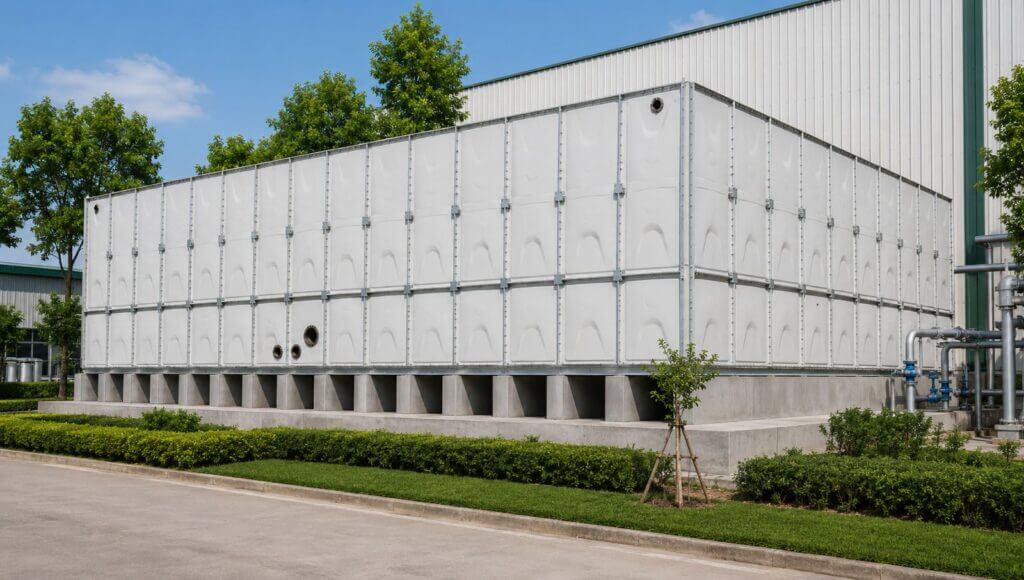
GRP (glass-reinforced plastic) tanks are assembled from moulded panels. Because GRP does not rust, it is popular for coastal sites, rooftops and corrosive water. The panels are lighter than steel, the smooth surface is easy to keep clean, and insulated panel options help limit heat gain.
- Strengths: non-corroding, lighter to lift, hygienic surface and insulated options.
- Limits: often a higher cost per litre at large capacities, and quality varies between manufacturers, so check certification and panel thickness.
Our GRP panel water tank buyer's guide covers construction and where GRP beats steel.
Reinforced Concrete Tanks
Concrete tanks are cast on site and are common for very large or below-ground reservoirs. When well built they last a long time and can take almost any shape.
- Strengths: long structural life, custom shapes and easy integration with a basement or building structure.
- Limits: long construction and curing time, cracking that can lead to leaks if waterproofing fails, heavy foundations, and no option to relocate. Internal lining or waterproofing is needed for drinking water.
Where programme time matters, sectional tanks are often the faster route. Our underground water tanks guide covers when concrete still makes sense.
HDPE and Plastic Tanks
Polyethylene tanks are moulded in one piece, which makes them the simplest and cheapest option for small storage.
- Strengths: low cost, quick installation and easy handling for villas and small sites.
- Limits: capacity is limited by moulding size, poorly stabilised units can degrade or deform under UV and heat, and they are not suited to large or fire-water storage.
For temporary or portable needs, see our water storage services.
How Each Material Handles UAE Conditions
| Factor | Zincalume steel | GRP | Concrete | HDPE |
|---|---|---|---|---|
| Heat and UV | Good, reflective surface | Good, insulated options | Good, high thermal mass | Fair, needs UV stabiliser and shade |
| Humidity and coastal salt | Very good, check edges | Excellent | Good if well waterproofed | Excellent |
| Typical capacity | Small to multi-million litres | Small to very large | Very large | Small to medium |
| Installation speed | Fast | Fast | Slow | Very fast |
| Relocation | Possible (bolted) | Possible (bolted) | Not possible | Easy for small units |
| Upfront cost | Moderate | Moderate to high | High, plus long programme | Low |
This table is general guidance. Specific products vary, and heat control is worth planning for whatever you choose; see our guide to insulated water tanks and summer heat in the UAE.
Lifespan and Maintenance: What to Expect
Every material needs some care, and the failure points differ:
- Steel: inspect the coating at edges, bolts and fittings, and check the liner for wear.
- GRP: check panel joints, gaskets and sealant, since these are the parts that age first.
- Concrete: look for cracks, damp patches and failing waterproofing.
- HDPE: watch for surface chalking, bulging or brittleness after years of sun.
Whatever the material, regular cleaning matters as much as the tank itself. Our cleaning and disinfection guide sets out how often to do it.
Common Myths About Water Tank Materials
- "Concrete is always the most durable." A poorly waterproofed concrete tank can leak long before a well-specified steel or GRP tank shows any wear.
- "Plastic is always the cheapest." It is cheapest to buy at small sizes, but replacing a degraded tank early can cost more over time.
- "All steel tanks rust in the UAE." Standard mild steel does. A correctly specified Zincalume tank is designed for exactly these conditions.
- "The material decides the quality." Coating weight, panel thickness, liner quality and installation standards matter just as much.
How to Choose: Five Questions
- How much water do you need? Small volumes point to HDPE or GRP; large volumes point to steel, GRP or concrete. Use our water tank size guide to work out the number first.
- Where will it sit? Rooftops favour lighter GRP, ground level suits steel, and below grade suits concrete or purpose-rated tanks.
- What are you storing? Drinking, fire, grey, black and brackish water each have different requirements. Fire tanks in particular are regulated; see our fire water tank guide.
- How fast do you need it? Sectional tanks can be erected far faster than concrete tanks can be poured and cured.
- What is the lifetime cost? Look beyond the purchase price to cleaning, repairs and lifespan. Our article on why high-quality water storage tanks matter shows how cutting corners backfires, and the water tank price guide explains cost drivers.
Our Recommendation by Project Type
- Villa: HDPE or a small GRP tank.
- Apartment or commercial rooftop: insulated GRP.
- Factory, camp or site at ground level: Zincalume steel. See our guide to industrial water storage tanks.
- Fire water reserve: steel tank designed to the fire protection requirements.
- Very large below-ground reservoir: reinforced concrete or a purpose-rated underground tank.
These are starting points, and a site survey can change the answer. To talk it through, contact Al Karwan Solution FZC.
Frequently Asked Questions
Is GRP better than steel for water tanks?
Neither wins in every case. GRP is stronger on corrosion resistance and insulation, which suits rooftops and coastal sites. Steel is usually better on very large capacities and cost per litre at scale.
Can steel tanks store drinking water?
Yes, when the tank has an approved food-grade liner and is cleaned and maintained properly. The steel provides the structure and the liner is the surface in contact with the water.
Are plastic water tanks suitable for the UAE?
They can be for small domestic use, provided they are UV-stabilised and kept in shade. For large volumes, rooftop loads or fire storage, a steel or GRP tank is a better choice.
Which type of water tank lasts the longest?
Well-built concrete, quality steel and quality GRP tanks can all last for decades. Lifespan depends more on material quality, installation and maintenance than on the material alone.