
Farming in the UAE is an exercise in water management. Rainfall is negligible, evaporation is high, and the water that is available — well water, tankered supply, treated sewage effluent — arrives on a schedule that has nothing to do with when crops need it. Storage is what bridges the gap. Get the capacity and the tank specification right and irrigation becomes predictable; get it wrong and you are either running dry in August or paying for storage you never fill. This guide covers how to choose agricultural water storage tanks in the UAE for farms, nurseries, landscaping contracts and greenhouse operations.
Why Agricultural Storage Is a Different Problem
A building stores water for a day. A farm stores it for a cycle. The differences shape everything about the tank:
- Volume is much larger. Irrigation demand is measured in tens or hundreds of cubic metres per day, not litres per person.
- Supply is intermittent. A well pumps on a permitted schedule, a tanker arrives when it arrives, and TSE supply runs to a network timetable. Storage has to decouple supply from demand.
- Water quality varies. Brackish well water and treated effluent are both far more aggressive than municipal water, and the tank has to survive them.
- Demand is seasonal. Peak summer irrigation can be double the winter figure for the same planting.
- It is not drinking water. Potable certification is unnecessary, which widens the options and lowers the cost.
Sizing Storage for Irrigation
Work from crop water requirement, not from guesswork. The method:
- Find your daily peak demand. Irrigated area in square metres × peak daily application rate in litres per square metre. For open-field agriculture in the UAE summer, 6 to 10 litres per square metre per day is a common planning range; protected cropping and drip systems are lower, open landscaping and turf can be higher.
- Decide the buffer days. How long must you irrigate with no incoming supply? For a well with a daily permit, one to two days is often enough. For tankered supply or a weekly TSE allocation, three to seven days.
- Multiply, then add a margin. Peak daily demand × buffer days, plus 15 to 20 percent for growth, pump losses and the dead volume below the outlet.
A worked example for a five-hectare date and fodder operation:
- 50,000 m² irrigated area
- Peak application 7 litres/m²/day = 350,000 litres per day
- Two days of buffer = 700,000 litres
- Plus 15 percent margin = approximately 800,000 litres of storage
At that scale you are into large sectional tanks, and often two or three tanks rather than one — which has the useful side effect of letting you take one out of service for cleaning without stopping irrigation. Our water tank sizing guide covers the arithmetic in more detail.
Matching the Tank to the Water You Actually Have
This is the decision that determines whether the tank lasts twenty years or five.
Brackish and Saline Well Water
Most UAE groundwater is brackish, and salinity attacks steel. For brackish water the tank needs either a GRP construction or a steel tank with a food-grade internal liner that isolates the water from the panels entirely. Bare galvanised steel holding saline water will pit and fail early. Our comparison of GI vs Zincalume tanks explains the coating differences.
Treated Sewage Effluent (TSE)
TSE is widely used for landscaping and non-food irrigation in the UAE and is usually supplied at low cost. It carries nutrients and residual chlorine, encourages biofilm, and must be strictly separated from any potable system. TSE tanks need clear labelling, dedicated pipework with no cross-connection, a liner suited to the water, and a cleaning schedule that accounts for biofilm.
Fertigation
If you are dosing fertiliser into the irrigation water, the tank is holding a mild chemical solution. Dose downstream of the storage tank where possible. Where mixing happens in the tank, the liner specification has to account for it — tell your supplier, because a standard liner may not be suitable.
Tank Types for Agricultural Use
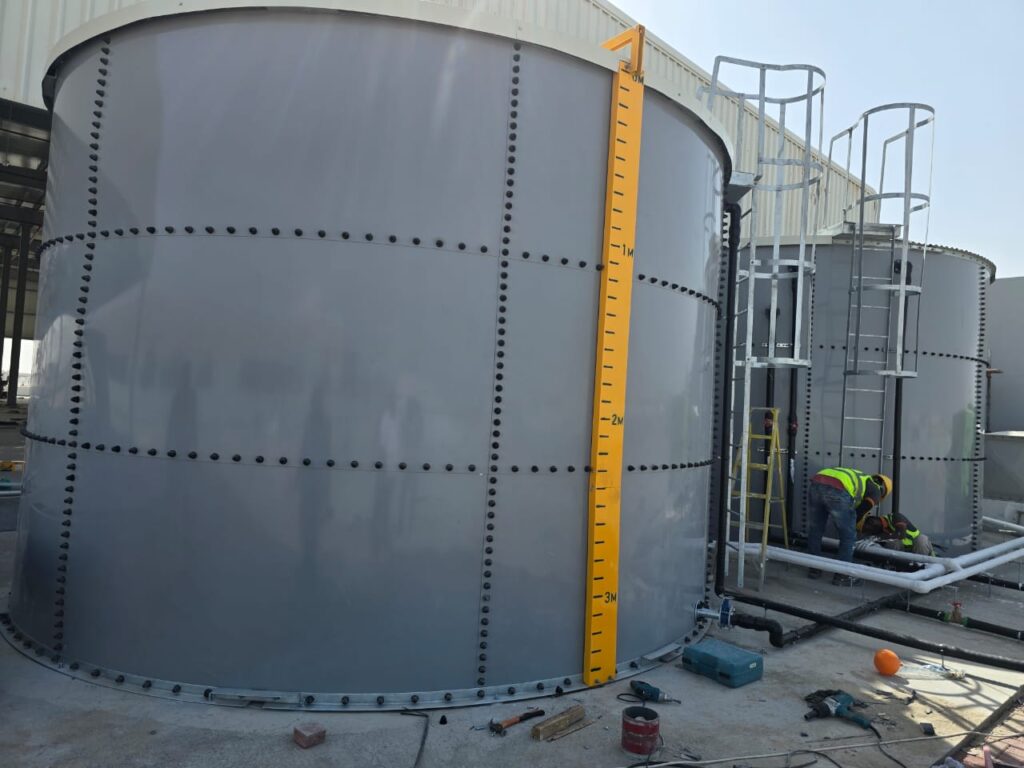
Sectional steel tanks (Zincalume or galvanised, lined) are the usual answer above about 50,000 litres. They are built from bolted panels on site, so capacity is effectively unlimited, and a liner handles difficult water. Our Zincalume sectional tanks run from 5,000 up to 5,000,000 litres.
GRP panel tanks suit mid-range capacities, corrosive water and situations where keeping the water cooler matters — a nursery with sensitive stock, for example. They are also lighter to handle on a remote site.
Moulded HDPE tanks are cheap and quick for small holdings, greenhouse day tanks and buffer vessels up to around 10,000 litres. They do not scale to farm volumes economically.
Underground and partially buried tanks keep water noticeably cooler and free up surface area, at a higher construction cost. For a remote farm this can be worth it in summer. See our underground water tanks guide.
For a direct material comparison, read steel vs GRP vs concrete water tanks.
Heat, Algae and Evaporation
Warm, nutrient-rich, sunlit water grows algae, and algae blocks drip emitters. Three measures deal with nearly all of it:
- Keep light out completely. An opaque tank with a sealed cover stops algae at the source. This is the single most effective step, and it is free if you specify it correctly at the start.
- Insulate or shade. Cooler water holds more dissolved oxygen, grows less biofilm and is better for root zones. It also cuts evaporation losses from the tank itself.
- Filter before the emitters. A screen or disc filter between tank and irrigation line protects the drip system from whatever does grow or settle.
Our guide to insulated tanks in summer heat covers the options.
Integrating Storage With the Irrigation System
The tank is one component in a chain, and the connections matter as much as the vessel:
- Inlet above maximum water level, so tank water can never siphon back towards the well or the supply main.
- Outlet raised slightly off the floor, so settled silt is not drawn into the pump. Add a separate low-level drain for flushing.
- Pump sized for the irrigation duty, not for the tank. Confirm the flow and head the system needs at peak.
- Level control and dry-run protection. A float switch or level sensor that stops the pump before the tank empties will save the pump. On a remote farm, a telemetry alert is worth the cost.
- Overflow routed somewhere harmless, screened against insects, and never into a drinking water system.
- Access for cleaning: a lockable manhole, a ladder and a drain point.
Siting and Foundations on a Farm
Farm ground is rarely ready for a filled tank. A 500,000-litre tank is 500 tonnes of water: the base is a structural element, not a slab poured to level the ground.
- Get the ground-bearing capacity checked, and build a reinforced concrete base or plinths designed for the filled load.
- Site the tank high enough to give useful gravity head where that suits the irrigation layout, and far enough from trees to avoid root damage and leaf litter.
- Leave working space on all sides. Tanks need to be inspected, cleaned and occasionally repanelled.
- Think about delivery access. Panel tanks arrive flat, which is a real advantage on a farm track, but the vehicle still has to reach the site.
Our installation process guide sets out the sequence from survey to commissioning.
Maintenance Through the Season
Agricultural tanks are usually the least maintained tanks we see, and the failures are predictable:
- Clean annually, before peak season. Silt accumulates fast with well water. See our cleaning and disinfection guide.
- Flush the low-level drain monthly through the irrigation season to remove settled solids.
- Service the filters on the schedule the irrigation system needs, which is more often than you think in summer.
- Inspect panels, bolts and the liner annually. A small liner tear is cheap to patch and expensive to ignore.
- Check level controls before the season, not during it.
Agricultural Water Tanks From a Sharjah Manufacturer
Al Karwan Solution FZC manufactures sectional steel and GRP panel water tanks in Sharjah and supplies farms, nurseries and landscaping contractors across the UAE. Manufacturing locally means tank dimensions can be built to suit the plot and the base, liners can be specified for brackish or TSE water, and lead times stay short through the planting calendar.
To quote an agricultural project we need: irrigated area and crop or planting type, water source and a salinity figure if you have one, supply schedule, available plot area and ground conditions, and your target capacity or the buffer days you want to cover. See our services or browse completed projects.
Frequently Asked Questions
What size water tank do I need for a farm in the UAE?
Multiply your peak daily irrigation demand by the number of days you need to cover with no incoming supply, then add 15 to 20 percent. For open-field agriculture, peak demand is commonly 6 to 10 litres per square metre per day. A five-hectare operation needing two days of buffer works out at roughly 800,000 litres. The buffer figure depends on your water source — a permitted well needs less than a weekly tanker delivery.
Can a steel water tank hold brackish well water?
Only with a suitable internal liner. Bare galvanised steel in contact with saline water pits and fails early. For brackish groundwater we specify either a GRP tank or a sectional steel tank with a food-grade liner that isolates the water from the panels. Tell your supplier the salinity if you have a figure, because it affects the liner specification.
Can I use treated sewage effluent (TSE) in a standard water tank?
TSE needs a tank dedicated to it, with clear labelling, no cross-connection to any potable system, a liner suited to the water, and a cleaning schedule that accounts for biofilm. It must never share storage or pipework with drinking water. TSE is widely used for landscaping and non-food irrigation in the UAE and is a sensible low-cost source when the system is set up properly.
Is it better to have one large tank or several smaller ones?
Above roughly 200,000 litres, several tanks is usually the better engineering answer. You can take one offline for cleaning or repair without stopping irrigation, the individual foundation loads are lower and easier to build for, and you can phase the capital cost as the operation grows. The trade-off is slightly more pipework and more connections to maintain.