
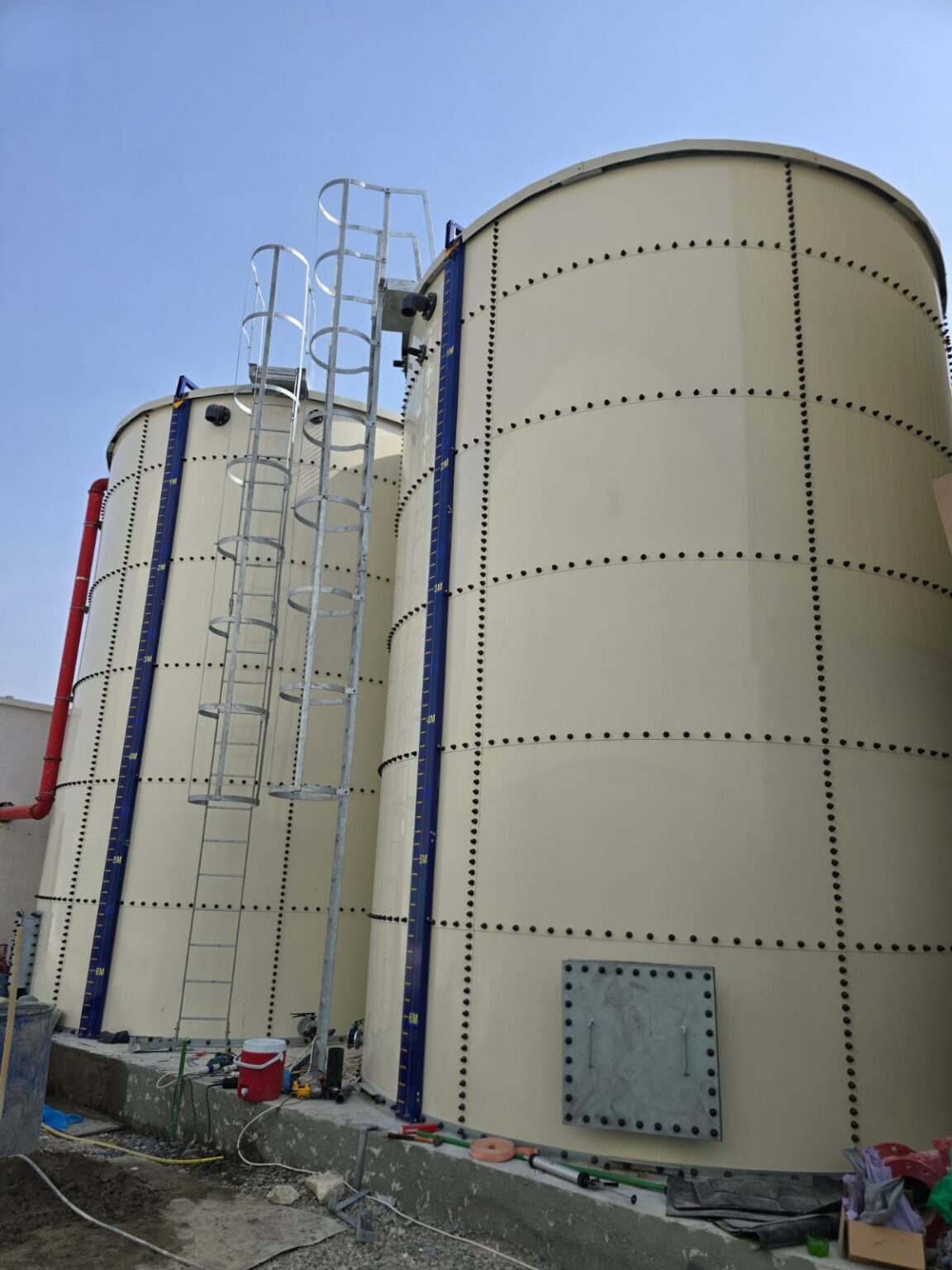
Standard tanks fit standard spaces, and very few real projects have one. A plant room is a metre too short, a roof has a beam running through the only clear area, a stairwell will not take a panel wider than 1.2 metres, or the water is brackish and needs a liner a catalogue product does not offer. That is where custom manufacturing earns its cost. This guide explains how custom water tank manufacturing works in Sharjah — the design process, what happens in the factory, what you need to specify, realistic lead times, and why a locally manufactured tank usually beats an imported one on a UAE project.
When a Custom Tank Is the Right Answer
A custom sectional tank is not automatically better than a standard one. It is better when the project has a constraint a standard product cannot meet:
- The space is awkward. A tank built to the available footprint recovers capacity that a standard size wastes. In a plant room or on a roof, 300mm either way changes what fits.
- Access is restricted. Panel dimensions can be chosen to pass through a specific door, hatch or stairwell. This is often the deciding factor on an existing building.
- The water is difficult. Brackish groundwater, TSE, process water or elevated temperature all affect the liner and coating specification.
- Capacity is large or phased. Sectional construction scales to millions of litres and can be extended later.
- Compliance is specific. A fire reserve, a potable certification requirement or a particular connection schedule has to be designed in, not adapted afterwards.
- Height is constrained. A wide, shallow tank and a tall, narrow one can hold the same volume. Which one you can build depends on the room.
If your requirement does fit a standard configuration, say so — a standard tank will be quicker and cheaper, and a good manufacturer will tell you that.
Step 1: Enquiry and Site Survey
Everything downstream depends on getting this right. For a custom tank we need to establish:
- Required capacity, or the occupancy and usage to calculate it from. Our sizing guide covers the method.
- Available space: length, width and clear height, including anything intruding into it — beams, pipes, ducts, columns.
- Access route from the delivery point to the final position, with the narrowest dimension measured rather than estimated.
- Location: rooftop, ground level, plant room, underground, outdoor.
- Water type and use: potable, industrial process, irrigation, fire reserve, brackish, TSE.
- Structural capacity, confirmed by your engineer for a rooftop or elevated installation.
- Connections: inlet, outlet, overflow, drain, with sizes and positions.
For anything other than a straightforward ground-level tank, a site survey is worth the time. Measuring the room is quick; redesigning a tank that will not fit through the door is not.
Step 2: Design and Drawings
With the survey information, the design work covers:
- Panel layout. Sectional tanks are built from standard panel modules — commonly 1m × 1m and 1m × 0.5m — arranged to make up the required dimensions. The grid is what makes custom sizes economical, because the panels themselves stay standard.
- Structural design. Internal tie rods and external bracing sized for the hydrostatic load at full capacity. The taller the tank, the higher the pressure at the base and the heavier the bracing.
- Material and coating. Zincalume, galvanised steel or GRP, with the internal liner specified for the water type.
- Base design. The steel frame or plinth layout that transfers load to the supporting structure.
- Accessories and connections. Manhole, ladders, level indicator, vent, screened overflow, drain, and the connection schedule.
You should receive drawings showing dimensions, panel arrangement, connection positions and the base layout, plus the filled weight for your structural engineer. Approve these before manufacturing starts — changes are inexpensive on a drawing and expensive in a factory.
Step 3: Manufacturing
Panels are produced at our Sharjah facility. The sequence is:
- Material preparation. Steel sheet is cut to panel size, or GRP panels are moulded.
- Forming. Panels are pressed to profile. The profile is what gives a thin panel its stiffness against water pressure.
- Coating and finishing. Zincalume arrives pre-coated; additional protection is applied where specified.
- Fabricating the structural components. Tie rods, bracing, base frame and support members.
- Connections and accessories. Flanges, nozzles and fittings are formed and fitted to the drawing schedule.
- Inspection. Panels are checked for dimensional accuracy and coating integrity before despatch.
- Packing. Flat-packed by panel group with the bolts, gaskets, sealant and fittings for each.
Flat-pack despatch is the practical advantage of sectional construction: a 200,000-litre tank travels on a standard flatbed and goes up a stairwell by hand.
Step 4: Delivery and Site Preparation
Site preparation runs in parallel with manufacturing, and it is the part most often behind schedule:
- The base must be complete, cured and level before panels arrive. A reinforced concrete slab, plinths or a structural steel frame, designed for the filled load. Out-of-level bases are the most common cause of installation delay and of later joint leaks.
- Clear access and working space around the tank footprint for assembly.
- Pipework roughed in to the connection positions on the approved drawing.
- For rooftop work, a confirmed lifting or carrying plan and permits where the building requires them.
Step 5: Installation and Commissioning
On-site assembly follows a set order:
- Base frame positioned and levelled.
- Floor panels laid and bolted with gaskets and sealant.
- Wall panels built up course by course, with tie rods and bracing installed as the height increases.
- Roof panels fitted, with the manhole and vent positions set out.
- Internal liner installed where specified.
- Accessories fitted: ladders, level indicator, screens, connections.
- Hydrostatic test — fill and hold to check every joint under real pressure.
- Clean and disinfect, then connect to the supply. For potable tanks this step is mandatory and should be documented.
Our installation process guide covers the sequence in more detail, including what to witness and what to get in writing.
Realistic Lead Times
Indicative timescales for a custom tank, assuming prompt decisions on your side:
- Survey and quotation: a few days from enquiry.
- Design and drawing approval: dependent on how quickly drawings come back approved. This is usually the longest variable.
- Manufacturing: from a few days for a small standard-material tank to several weeks for a large or specialised one.
- Installation: one day to a couple of weeks depending on capacity, access and whether the base is genuinely ready.
The two things that move a programme are drawing approval and base readiness. Neither is in the manufacturer's hands, and both are worth managing from the start. Note that an imported tank adds shipping and customs to all of the above, and a variation after despatch means a new shipment rather than a new panel.
What to Give Your Manufacturer
Bring this to the first conversation and the quotation will be accurate rather than indicative:
- Required capacity in litres, or the occupancy and usage to size from.
- Maximum available length, width and height, noting obstructions.
- Narrowest dimension on the access route.
- Installation location and whether the structure has been checked.
- Water type and temperature, and a salinity figure for groundwater if you have one.
- Whether the tank serves potable, process, irrigation or fire duty.
- Connection sizes and preferred positions.
- Any authority or consultant requirements you have been given.
- Your required completion date.
If you do not have all of it, say what you do have. A survey fills the gaps, and an honest unknown is better than a guess that ends up on a drawing.
Why Local Manufacturing Matters Here
For a UAE project, a tank manufactured in Sharjah has concrete advantages over an imported one:
- Dimensions to suit the site, because the panels are made after the survey rather than selected from stock.
- Short lead times, with no shipping or customs in the critical path.
- Changes are practical. A late dimensional change is a factory adjustment, not a new container.
- Specification for local conditions: 50°C summers, high UV, brackish groundwater and coastal humidity.
- Local support. Spare panels, gaskets and service from a team in the country, for the life of the tank.
- Site attendance. Someone can be on site tomorrow if something needs checking.
Al Karwan Solution FZC manufactures sectional steel and GRP panel water tanks in Sharjah, from 5,000 up to 5,000,000 litres, and supplies contractors, consultants, facility managers and industrial clients across the UAE. We also fabricate tank accessories, steel structures and related products at the same facility.
To discuss a custom tank, contact our team with your capacity, available space and access route. You can also see our services or browse completed projects.
Frequently Asked Questions
How long does it take to manufacture a custom water tank?
From approved drawings, manufacturing runs from a few days for a small tank in standard materials to several weeks for a large or specialised one. The two things that usually set the overall programme are how quickly drawings are approved and whether the base is ready when panels arrive — neither is in the manufacturer's control, and both are worth managing from day one.
Can a sectional tank be built to a non-standard size?
Yes, and that is the main reason to choose sectional construction. Tanks are assembled from standard panel modules, typically 1m x 1m and 1m x 0.5m, so dimensions can be varied in steps to suit the available space while the panels themselves stay standard. That is what keeps a custom size economical.
Can a tank be installed where access is very restricted?
Usually, yes. Panel dimensions can be chosen so that components pass through a specific door, hatch or stairwell, and the tank is then assembled in position. This is a common requirement on existing buildings and plant rooms, and it is the main reason sectional tanks are used where a single moulded tank could never be delivered. Measure the narrowest point on the route and tell us at the survey stage.
Can capacity be extended later?
Bolted sectional tanks can often be extended, and phased capacity can be designed in from the start. It is far easier if the intention is known at the design stage, because the base, bracing and connection positions can be laid out for the final size. Tell us about planned expansion at the enquiry rather than after the tank is built.